Table of Contents
- Christmas crochet pattern materials and abbreviations
- Before you start: color and scale
- Crochet the main ornament piece
- Make the Christmas accent pieces
- Sew, stuff and attach the hanger
- Make it your own and fix common issues
- Display, storage and care
- More woodland Christmas crochet ideas
- Frequently asked questions
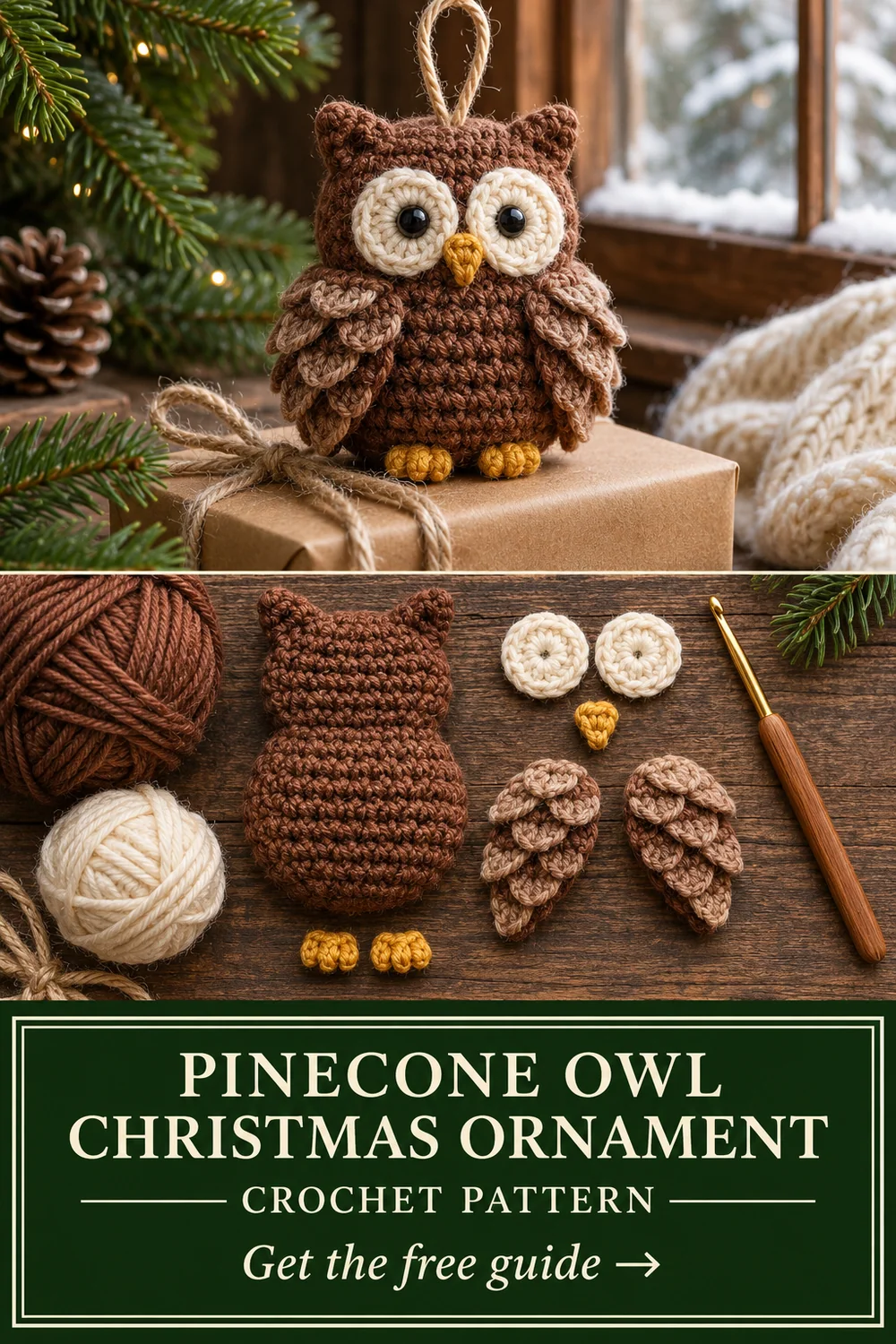
This pinecone owl christmas ornament joins our rustic Christmas crochet patterns for small handmade gifts and tree decorations. The owl is a compact oval with two pointed ear tufts and overlapping scale-like wing patches. Cream eye discs keep the bird readable against its brown pinecone texture. Follow the written rows or rounds below, then use the assembly notes to make it hang straight. The sample is a compact ornament; its exact size depends on yarn, hook and your tension.
Christmas crochet pattern materials and abbreviations
Gather warm brown, cocoa and cream DK yarn, a 3 mm hook, a little filling, a stitch marker, embroidery thread, tapestry needle, and yarn for the loop. Use a hook small enough to make a firm fabric. US terms: ch = chain, sc = single crochet, sl st = slip stitch, hdc = half double crochet, dc = double crochet, inc = two sc in one stitch, invisible dec = single crochet the front loops of two adjacent stitches together. R denotes a round; Row means turn at the end. The number in parentheses is the count at the end of that instruction.
Try a few stitches in your chosen yarn before beginning. If the fabric has gaps, use a smaller hook; if the yarn squeaks or the edge puckers, relax your tension. Always recount after an increase or decrease round.
Before you start: color and scale
Choose the face placement first. Pin the eyes on the upper front, one stitch apart, so the pinecone texture stays along the sides instead of swallowing the expression. Embroider the beak with three short saffron stitches. Lay the yarn and any natural materials on a table in daylight to check their contrast. Keep the hanging loop in a matching shade so it does not distract from the motif. For a set of five ornaments, the same yarn weight makes the pieces look related even if the shapes differ.
Make one complete ornament first and record its finished height. Yarn weight and hook size change the measurement more reliably than changing just the stuffing. Avoid adding a rigid component to pieces that will be handled by small children.
Crochet the main ornament piece
Body, in brown: R1 6 sc in a magic ring (6). R2 inc in each stitch (12). R3 [sc, inc] six times (18). R4 [2 sc, inc] six times (24). R5–9 sc around (24). R10 [2 sc, invisible dec] six times (18). R11 [sc, invisible dec] six times (12). Stuff lightly. R12 invisible dec six times (6); close.
Take a moment to compare the front and back if your design uses flat panels. Pin alignment points before you sew; on a piece worked in rounds, move the marker at the start of each round. Count after shaping so the next section starts with the intended number of stitches.
Make the Christmas accent pieces
Eyes, make two in cream: 6 sc in a magic ring; slip stitch into first sc and fasten off with a sewing tail. Wings, make two in cocoa: ch 7, sc into second ch and across (6); ch 1, turn, sc across (6); repeat this row twice. For a raised scale, work a three-dc bobble in the third stitch of each of the final two rows instead of sc.
Use tight single crochet rounds for the body and small raised bobbles on separate wing patches to suggest pinecone scales. A bobble is three unfinished double crochets in one stitch closed together; test it on a scrap before starting. Stitch the smallest details in a contrasting color if they need to stand out. Finish and weave in each short yarn end as soon as a piece is complete; otherwise the ends can make the seam bulky.
Sew, stuff and attach the hanger
Ear tufts: ch 4, slip stitch into second chain, sc in next and hdc in last; make two. Pin the eyes two stitches apart on the upper face. Sew wings to either side, points downward; sew tufts to the top edge. Embroider a small V beak and pupils; chain 22 in matching yarn and secure behind the crown.
Stuff the body lightly while closing its last rounds. Sew on the eyes, embroider pupils and beak, then attach the wings. Catch the ear tufts in the top seam and anchor the hanging loop between them so the owl faces forward. Hold the ornament by its loop for several seconds, then turn it to the side. Move the loop slightly before weaving in its tails if the motif leans. Secure the yarn on the hidden face with stitches that pass through the fabric, not just the stuffing.
Make it your own and fix common issues
Try caramel wings on a chocolate body for stronger scale contrast, or leave the bobbles off for a simpler beginner owl. A narrow holly-green loop brings in a Christmas accent without covering the face. Keep the written counts the same for a color change. If you change yarn weight, make all the pieces in that new weight and test how the finished ornament hangs.
Heavy stuffing makes a pinecone owl round like a ball. Remove a little filling and flatten front to back. If bobbles hide the eye discs, shift the wing patches two stitches toward the back and re-pin before sewing. If an edge still curls after you adjust the tension, gently reshape the piece on a towel. Do not press a hot iron on acrylic or filled pieces. Check seams and small decorations before wrapping a gift.
Display, storage and care
Hang the piece away from open flame and heavy moisture. To store it after Christmas, tuck the ornament loosely in tissue rather than compressing any raised stitches. If it includes a natural element, let it dry completely before storing and check it for wear before putting it back on the tree.
For a cohesive handmade set, pair this motif with the other woodland Christmas ornaments on the site. A shared palette of pine green, cream and warm brown ties different shapes together without making every ornament identical.
More woodland Christmas crochet ideas
Keep making a coordinated tree set with these related ornaments and explore our crochet ideas collection:
- Rustic Cinnamon Stick Christmas Tree
- Snow-Dusted Fir Christmas Tree
- Gingerbread House Christmas Ornament
- Holly Berry Robin Christmas Ornament
Frequently asked questions
What gives this Christmas owl its pinecone texture?
Place the three-double-crochet bobbles on the side wing patches. Keeping the 24-stitch body smooth preserves the contrast with the raised pinecone scales.
Can I skip the bobble stitch?
Yes. Work the two wings as six-stitch-wide flat sc panels in cocoa yarn; the owl’s cream eye discs and pointed ear tufts will still establish its face.
How do I stop the ornament from facing backward?
Make a 22-chain loop and fix both ends behind the center between the ear tufts. Hang it briefly before hiding the yarn tails to check that the eyes face forward.
Are plastic safety eyes needed?
No. Crochet each eye disc with six cream single crochets in a ring, then embroider the pupil and small beak so no separate plastic parts are needed.